
COPY: The American Badger: My Favorite Local Animal
by Naturalist Candace Rho
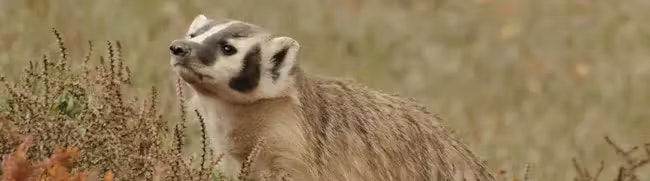
The American badger (Taxidea taxus) is easily my favorite mammal that lives here with us in Livermore, California.
Badger Spotting in the Park
One sunny but chilly day, while I was working in Sycamore Grove Park last year, routine park visitors stopped in the Wetmore Nature Center to share how they saw an American badger scurry in front of them across one of the trails around 30 or 40 years ago. I hope to see one myself someday!
Friend Shaped But Not Friendly
Taxidea taxus, the scientific name for the American badger, has a sweet and adorable face (with sharp teeth), dark brown patches and white stripes, a broad and flat head, small ears, and a stubby tail. The size proportion of its small head and large body can be a silly sight. These badgers are great meat eaters and perfect grassland hunters/predators.
Even though they are friend-shaped (they look like very big and plushy stuffed animals), they do not view people the same way we view them. It is very important to respect them and to remember they have wicked teeth and claws. If you ever cross paths with a badger, make sure you give it space! This critter may not look like a speed racer, but beware, it can reach up to 19 mph! How fast can you run?
(Editor’s note: We must be explicit here,
DON'T PICK UP BADGERS!)




Ecosystem Engineers
The National Park Service continues the description by explaining this species of badger, “...are medium-sized mammals with stocky bodies, short legs, and a tapered head...and their torso’s coarse fur is thatched with black, brown, and white hairs, giving their coat a unique blended appearance” (NPS, 2025). The American badger is a very robust and strong animal; it is equipped with long, sharp claws and a streamlined body designed for digging and tunneling (NPS, 2025). There is no doubt that they are ecosystem engineers.
Ecosystem engineers are vital in supporting the foundation of a local network of organisms. Digging ecosystem engineers like the American badger provide habitat for most wildlife on the ground, and support the foundation of the local food web. Since the American badger specializes in tunneling underground, these burrowing animals create vast landscapes, underground highways, and underground cities for wildlife to thrive below the surface. Furthermore, the American badger indirectly aerates the soil, disperses plant seeds, and directly controls populations of smaller mammals and rodents to help balance the food web.
Pest Control & Earthbenders
These badgers are mostly carnivorous; they love to eat ground squirrels, rats, prairie dogs, gophers, and mice. They could be viewed as pest control! However, American badgers are not picky; they will hunt snakes, other reptiles, insects, eggs, various plants, and birds. Sometimes they save their leftovers by burying them somewhere, saving the food for later. The cool underground dirt acts as a natural refrigerator and shields the carrion, or dead animal, from other scavengers.
Click here to watch an American badger bury a cow calf!
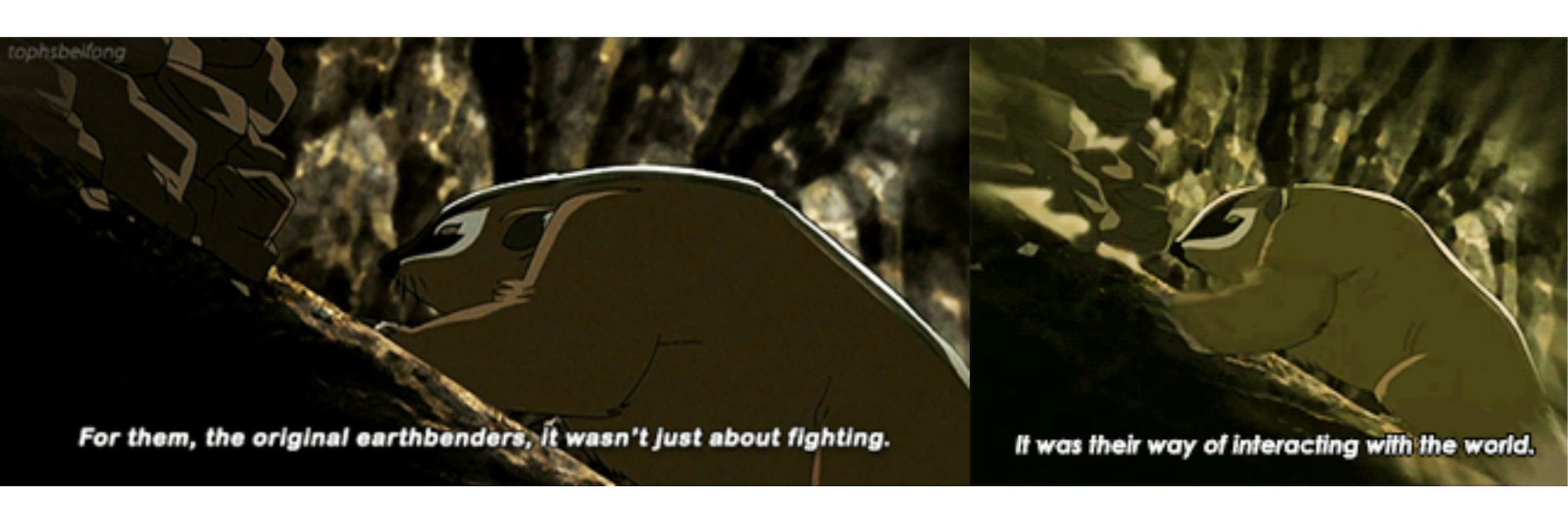
This scientific research directly shows the power, strength, and stamina that American badgers use to sculpt the earth. The creators of Avatar: The Last Airbender knew this, too.
If you have not yet watched Avatar: The Last Airbender, I highly recommend this low-commitment series. It is a great family-friendly show and very fun to watch for all ages; I will be rewatching it soon! This is a piece of modern media that recognizes the power of earthbenders and ecosystem engineers, like the badger.
Elusive but Abundant
There are several species of badger around the world. I would say Livermore is extremely lucky to be home to the American badger. These creatures are normally solitary, but they could sometimes be in breeding pairs or in family units. The American badger has an enormous range throughout North America, spanning from the Midwest, north to Canada, south to Texas, and out west to California. Even though the badger is widely distributed throughout the continent, it is pretty elusive and not often seen, especially in the East Bay of California. While this could partly be because of their nocturnal behavior, where they prefer to be active at nighttime, the biggest impact may be humans. Over the last century, humans have turned nonhuman nature (natural environments) into synthetically constructed built environments, also known as human nature/human development.
Sightings are Rare
Changes in land use may be the biggest threat to the American badger. Examples include the dramatic shift of grasslands, savannahs, and other habitats into agricultural land, roads and highways, and other developments, which divide and fragment nonhuman nature, cutting off open space and shrinking badger habitat.
Locally, most modern-day sightings of badgers or badger signs are outside the city, in the hills. A badger burrow was sighted on the north side of Brushy Peak in 2024, and in 2025, a badger popped up on a trail cam in the hills above Sycamore Grove.
I want to give a big thank you to all the Sycamore Grove Park visitors for supporting local open spaces, preserving habitat, and helping all wildlife have a home in the same city we live in.