Valley Wilds Article | Tangled Webs
by Ranger Vickie Eggert
Spiders spin silk for a variety of purposes
From sacs to hold their eggs to tightrope-like lines to walk on and traps that capture prey, spiders have many uses for the silk they spin. Their silk is made up of proteins called “spidroins,” which are made in the spinnerets. Spinnerets are special glands in the spider's body which produce silk. The proteins are spun together and delivered through tubes called labellum. Only spiders can produce this type of protein, and they can continue to produce webs their entire life. Because it is spun in a single direction, silk is hard to tangle, and it also makes a good insulator.
Distinct types of silk
The most common type of silk is dragline silk, which makes up the main, straight lines of a spider's web and are used for safety lines. A sticky silk called flagelliform silk is used for wrapping prey. Cribellate spider silk consists of protein filaments mainly used to create a sticky layer on their feet. Aciniform silk serves as a safety line to help spiders catch their prey in mid-air.

Image: dragline silk image

Webs be stylin'!
Just as there are many different types of silk, there are several different styles and uses as well. Some spiders spin webs in a circular pattern, like the orb weavers. These are the typical Halloween webs you see in decorations.
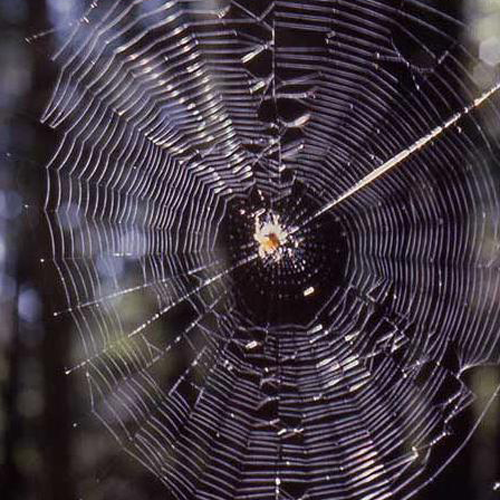
Image: Orb spider web

Some spin messy masses of webbing all around them like the black widow.

Image: Black widow spider web

Some work together in a large colony to create a massive combination of webs to capture larger prey. Trapdoor spiders use their silk mixed with soil and leaves to make a doorway to cover their burrow so they can hide in it and wait to ambush their prey.

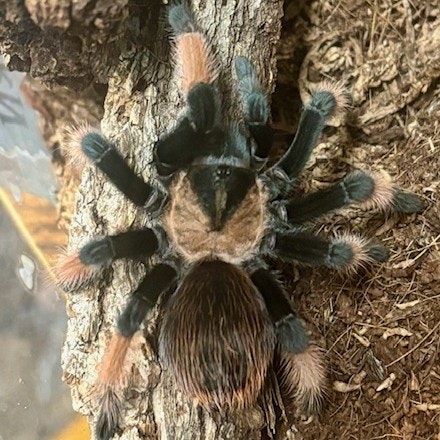
Tarantulas can spin webs through their front legs as well as their abdomen. Diving bell spiders dive underwater and use their silk to weave a container to secure air bubbles to their abdomen so they can breathe.

Image: Diving bell spider web

Spiders also have been known to put chemicals on their webbing for various purposes including pheromones to attract a mate (Wandering wolf spider) and neurotoxins to help capture prey (Golden Orb Weaver). Some spiders, like the dewdrop spider, also use other spiders’ webs to help them catch prey, or they may eat the host spider itself. They will then simply grab prey out of other spiders’ webs.
Catch. Bite. Wrap. Drink.
Once the spider catches a prey item, it will usually bite the prey, injecting it with venom and digestive juices, and use its front legs to turn the prey while spinning silk wrapping it up around it like a mummy. With the prey encased in silk, the spider waits until the prey has died. It then drinks the now liquified insides of the trapped prey item.

Image: Spider prey in web

Arachnid Fun Facts
Did you know...
- In terms of strength-to-density ratio, spider silk is far stronger than steel. That means a strand of silk is much stronger for its size than a steel strand of the same size.
- A single strand of spider silk is 1,000 times thinner than a strand of human hair (1/10,000 inch wide).
- Some silk can be stretched up to four times its original length without breaking.
- Silk can retain its elasticity at temperatures as low as -40 degrees Fahrenheit.
Humans have used spider silk for thousands of years...
- Spider webs can be made into cloth, much the way silkworm silk is used.
- During 1940s military aviation, fighters and bombers used spider silk on their lenses to make crosshairs for aiming their guns.
- The ancient Greeks used cobwebs as bandages to stop bleeding and help clean and protect wounds.
- Many cultures turn spider webs into fishing nets.
- Webs are used in airplane wings
- Silk is used for surgical sutures
- No one has yet been able to duplicate spider silk, although some synthetics have come close.
Animals use spider webs, too...
- Hummingbirds and some songbirds use spider silk to make their nests. They weave strands into a cup shape and line the nest with other soft fibers. The strong spider silk helps hold the nests together.
- Some spiders, like the dewdrop spider, also use other webs to help them catch prey, or they may eat the host spider itself. They will simply grab prey out of other spiders’ webs.
Spiders and their webs are amazing and beneficial, although annoying when you are trying to clean them out of your house! They capture prey such as flies and mosquitoes that could otherwise harm humans.
Tarantula sightings
Our local tarantulas, the Desert Tarantula (Aphonopelma iodius), are likely deep within their burrows waiting out winter. However, now is a great time to plan to see them during their peak season in late summer and fall. You can still catch a tarantula sighting at Sycamore Grove Park or at a local classroom nature program. Our animal ambassador, Candy Corn, is hard at work spreading the good word for arachnids and their amazing silk.